
Why Nations Fail
An excursus on intergenerational trauma, blessings, and curses

"What's a feud?"
"Why, where was you raised? Don't you know what a feud is?"
"Never heard of it before—tell me about it."
"Well," says Buck, "a feud is this way: A man has a quarrel with another man, and kills him; then that other man's brother kills him; then the other brothers, on both sides, goes for one another; then the cousins chip in—and by and by everybody's killed off, and there ain't no more feud. But it's kind of slow, and takes a long time." Mark Twain, Huckleberry Finn
…
The first thing you should know is that I cut the Irish ghosts from this post.
I hope you’re not disappointed. A friend of mine perceived—quite rightly—that a writer shouldn’t sprint through complex terrain and we have a beguiling subject before us.
For several weeks we’ve been touring the story of Elijah the Prophet in Kings. It is exceedingly rich. And though we’ve been doing our best to contemplate their intriguing details, the prophetic histories are just so smart it’s inevitable that some literary emeralds would wind up on the cutting room floor.
In this post I want to discuss an element we’ve overlooked. Actually it’s almost always overlooked. And that’s too bad because it’s a shaping force in the story of the Bible and in the world, more generally.
That element is intergenerationality.
I realize that’s a wobbly word but it’s a big concept. Intergenerationality describes a broad range of phenomena that emerge in families and nations; it includes blood feuds, iniquity, intergenerational cycles of violence, and the downright eerie effect of blessings and curses on the fate of nations. Several forms of intergenerationality are, if not quite the main theme of the story in Kings, certainly in the top three.
To unpack those themes, spot me a thought experiment:
You have to answer the following question: Why do nations fail? Your answer will shape national policy and the work of the Church for centuries. What would you say?
If you grew up in the Splash Zone of the Protestant Reformation, the answer’s usually sin in its moral (rather than its ontological) sense: voluntary evil. People make destructive decisions and those add up over time. In that view, Israel’s descent into madness is the unflagging result of Ahab’s passivity and Jezebel’s manipulation. While that’s certainly part of it, it’s a paper-thin reading of the story.
What else can we say?
As a graduate student I had to read the economic classic, Why Nations Fail: The Origins of Power, Prosperity, and Poverty. How’s that for a subtitle? The origins of power? Let’s go! In that book the Delphic oracles of economics Daron Acemoglu and James Robinson made a simple argument: Institutions define national destinities. Prosperous nations get good institutions (in that book, things like democracy and capitalism) while poor nations get bad institutions (in that book, things like dictatorships and being a colony). It’s an interesting idea, and it’s actually in the story, too, but really—is that it? Ahab built mutual defense coalitions, expanded Israel’s trade networks, overhauled the army, and almost certainly expanded the elite class. And yet he plunged his country into hell.
Why?
Naturally, the Biblical answer’s complex. You have broken trust. You have nations becoming like their god. But one part at least is hidden in plain sight:
“Also, Jeroboam son of Nebat rebelled against the king. He was one of Solomon’s officials, an Ephraimite” (1 Kings 11:26).
Did you see that?
No?
How’s about here:
After Jeroboam rebelled, his son Nadab became king. Alas for Nadab, “Baasha son of Ahijah from the tribe of Issachar plotted against him” (1 Kings 15:27).
Eh?
Let’s look more closely.
Baasha’s from the tribe of Issachar; his son Elah is killed by Zimri. Though scholars debate these things, probably Zimri hailed from the tribe of Ephraim. Zimri was overthrown by Omri, from Issachar. Omri in turn fought Tibni, from Manasseh.
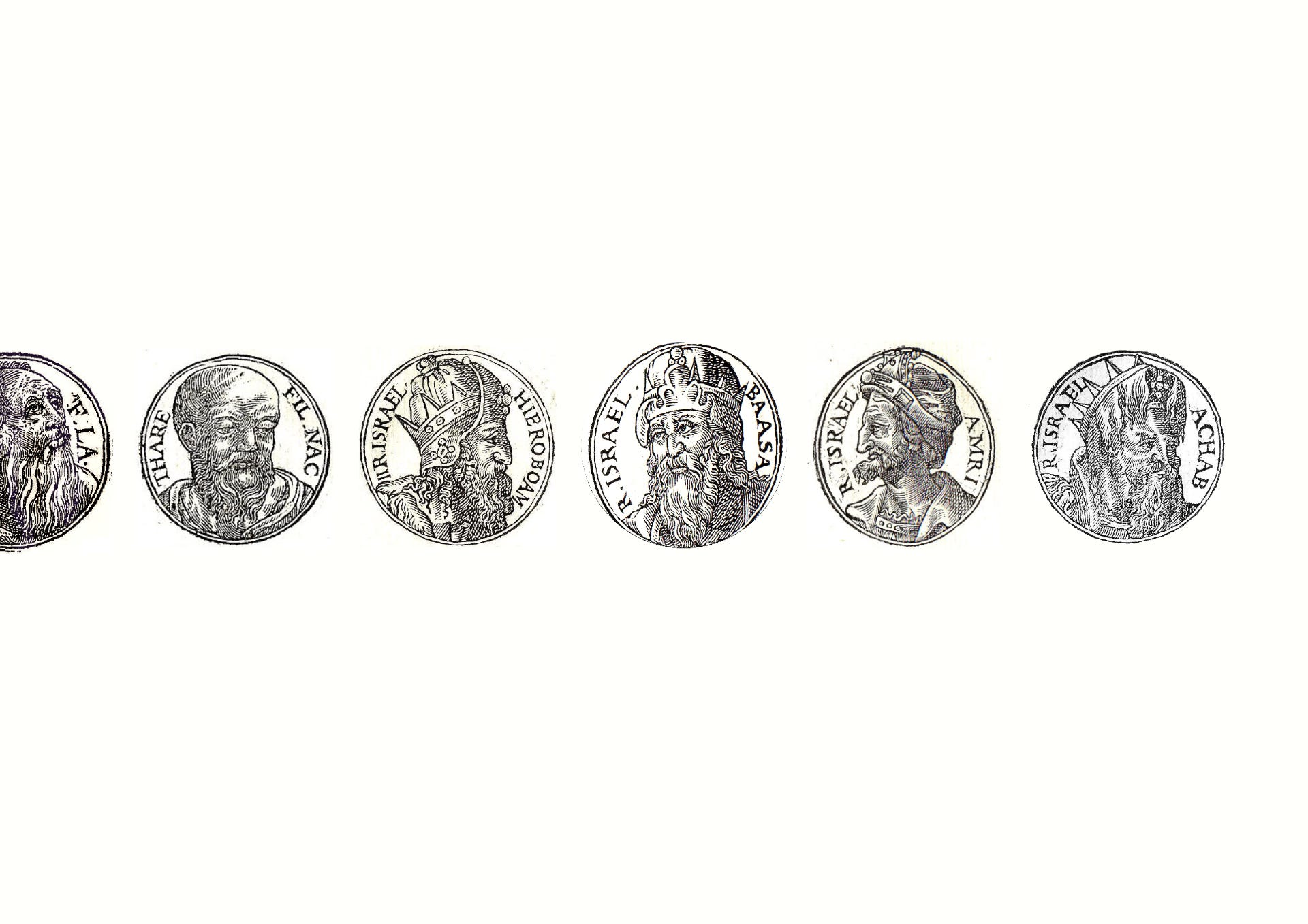
That matters because Ephraim and Manasseh together constituted the House of Joseph, and so the point is Ahab inherited a blood feud stretching back generations. The House of Joseph fought the House of Issachar, and their fight was just one part of a generational struggle reaching back to origins of Israel when Jacob spoke futures over his sons.
Here it is again: Ahab’s dealt a bad hand of intergenerational patterns; he inherits those alongside a set of ancient blessings and curses. His inability to resolve those curses partly causes the destruction of the Northern Kingdom.
…
The Bible has a lot to say about inherited evil and the most familiar type is called iniquity. Do a word study on it and you’ll discover a truly subtle concept. In its most basic form, iniquity, or “avon,” just means “bent,” which is a great way to start a conversation on evil (in the space trilogy, CS Lewis uses the word as a synonym for evil in the saga’s “Old Solar” language. Smart guy). It can mean lies, idolatry, and even bad politics. In fact, iniquity describes both willing evil and the environmental consequences of evil.
Iniquity includes ruined places, inherited mistrust, and institutionalized evil (among other things). Depleted soils are iniquity; they’re hard to farm. A paved road leading to a brothel is iniquity; it’s easy to walk that way. A judicial system that penalizes personality is iniquity; it sends people to prison.
Ahab inherits his father’s armies; it’s hard not to use those, if you happen to have them. Also, he inherits his father’s treaties. Also, he inherits Jeroboam’s cultic centers. The whole system seems rigged for Ahab to fail. As Metropolitan Kallistos Ware wrote:
“...we are born into an environment where it is easy to do evil and hard to do good; easy to hurt others, and hard to heal their wounds; easy to arouse men's suspicions, and hard to win their trust…we are each of us conditioned by the solidarity of the human race in its accumulated wrong-doing and wrong-thinking, and hence wrong-being. And to this accumulation of wrong we have ourselves added by our own deliberate acts of sin. The gulf grows wider and wider.”1
True enough, and the thing is, you don’t fix iniquity the way you fix sin.
Sin calls for confession and personal repentance; iniquity calls for contrition and national repentance. Inequality, says the Reverend J.T. Smith, calls for a civil rights movement; iniquity calls for a civil righteousness movement.
Amen. Ahab should have done what Hezekiah did, or what Josiah did. In fact, that’s what he was supposed to do. Ahab should have pledged himself to the covenant and begun the slow work of national renewal, changing the tax policy and freeing those slaves and moving that road and abrogating that treaty. At one point in the story, he comes very close to doing exactly that. But he doesn’t.
And that’s not the whole of it.
Iniquity represents one part of the intergenerational problem. Alongside iniquity, you’ve got the praeternatural power of blessings and curses.
For a master class in dynastic blessing, turn in your Bible to Genesis 49. You’ll find the words Jacob spoke over his sons before he died.
It is not an easy passage. As the academic Mariano Gómez Aranda observed, “Almost every verse contains a problem of translation or interpretation. Generations of scholars have tried to find solutions to the enigmatic expressions and riddles of this text.”2
True enough.
Read it, and you’ll see that most of the blessings of Genesis 49 seem to lack benediction. “Reuben shall not have preeminence.” “Simeon and Levi will be scattered.” “Gad is a snake.” The absence of blessing in those blessings is a public secret and students of the Bible have solved that problem in diverse ways.
(Note: The medieval Jewish scholar Abraham ibn Ezra argued that Jacob’s blessings are mentioned but not actually included in the text. “This is what their father said to them as he blessed them,” says Genesis 49:28, so Ezra’s proposal is certainly possible. Other scholars thought that Genesis 49 contains sundry tribal sayings, arranged for sake of convenience. There are stranger ideas—no less a sage than Rashi made this argument: “Jacob,” wrote he, “attempted to reveal the end, but the Divine Presence withdrew from him, so he began to say other things.” That would make for a tremendous caesura between Genesis 49:1 and Genesis 49:2, wouldn’t you say? Jacob, lost in thought, blanks on his blessings and so instead produces extemporaneous poetry. “Rashi,” wrote Aranda, “deduced that Jacob, having forgotten what he was going to say, made the best of the situation, and told them something else.”3)
(Question: do you like these asides in the text, as notes, or at the bottom of the post, as footnotes? I’ve tried both and prefer the latter but then this isn’t a book; you can’t exactly glance down to check the note here on the internet. Let me know what you prefer!)
Also, there’s this: “Gather yourselves together,” says Jacob, “that I may tell you what shall happen to you in days to come” (49:1).
That last phrase, “in days to come” is “be-aharit ha-yamim” in Hebrew; a more direct translation would read “in the last days.” The King James Bible, of perennial interest to scholars, puts the verse that way. In fact, many interpreters thought Genesis 49 contained not blessings but prophecies (the medieval Jewish scholars Ibn Ezra, the RaDaK, and Joseph Bekor-Shor thought so).
Which just goes to show you how much a worldview can fade from view over time because, in the Biblical imagination, there is no difference between a blessing and prophecy. Here’s why: Blessings bestow a future.
You can take as evidence Jacob’s malediction to Esau in Genesis 27 or Moses’s blessings from Deuteronomy 33, which build upon or else alter Jacob’s blessings.
In Genesis 49, Jacob assigns a future to each of his sons. And my, do his words reverberate:
To Simeon and Levi, Jacob says “I will scatter them in Jacob and disperse them in Israel.” That happens. Simeon is overlooked in Moses’s blessings; its territories are never differentiated from Judah’s. In the end Judah absorbs Simeon. Ditto Levi, though for different reasons.
To Dan, Jacob says, “You’ll be a snake by the roadside.” In Revelation, Dan is left out of the census of Israel; in fact, by the time John had his vision, Dan was closely associated with the spirit of antichrist.
Modern scholars—being, for the most part, dogged materialists—assume that Jacob’s blessings must have been written after the fact simply because they correspond so neatly to history. There’s no need for that to be the case, as we’ll soon see. And when it comes to Ahab, in Genesis 49, Issachar gets this banger:
“Issachar is a strong donkey,
crouching between the sheepfolds.
He saw that a resting place was good,
and that the land was pleasant,
so he bowed his shoulder to bear,
and submit to forced labor.”
Let me tell you, there are some odd interpretations of those lines (including, but not limited to, “forced labor” meaning “scholarly work,” which is an explanation only a scholar’d come up with). But in general three points come up:
1. Issachar means “hired man.” Between that and the line “bowed his shoulder to bear,” you get a clear picture of a pastoral people but also of spiritual oppression because:
2. “Forced labor” is an image of service to rebellious spiritual powers. In Joshua 23:13, for example, God says of the nations and their gods: “They shall be a snare and a trap for you, a whip on your sides and thorns in your eyes.” Issachar chooses those rebellious spirits on account of:
3. Wealth! “He saw that a resting place was good,” it says (Genesis 49:15). Issachar gets the immensely fertile Jezreel valley. It’s a place of reliable prosperity and it’s for that prosperity that first Omri and later Ahab swap service to Yahweh.
Put all that together and you get a workable portrait of Ahab, don’t you? The destiny is there, murmuring in Ahab’s blood, asserting itself. He could do something about it but he doesn’t; he just bobs along.
What could he do?
Before I answer that question let me name something intriguing: In our time, there has been a tremendous resurgence of interest in all this inherited evil stuff. It’s usually called “intergenerational trauma,” and professional interest in the phenomenon ranges from the material insights of epigenetics (consider the work of Peter Levine and Mark Wolynn) to the therapeutic study of Legacy Burdens (the IFS institute) to Resmaa Menakem’s exploration of the “Soul Nerve.”
The aforementioned disciplines get a lot right, friends. For example, the (brilliant) therapist Resmaa Menakem writes this about inherited evil:
“This intergenerational transmission—which, more aptly and less clinically, I call a soul wound—occurs in multiple ways:
• Through families in which one family member abuses or mistreats another.
• Through unsafe or abusive systems, structures, institutions, and/or cultural norms.
• Through our genes. Recent work in human genetics suggests that trauma is passed on in our DNA expression, through the biochemistry of the human egg, sperm, and womb.”4
That’s a pretty decent definition of iniquity, isn’t it? You could say the above about our man Ahab—as indeed, we have been. But it’s not complete. It’s missing the spiritual world as such, and it’s missing spirits with names. It should alarm us that for the moment the World seems more willing than the Church to explore and address iniquity and generational curses; it should alarm us because addressing iniquity and generational curses is the Church’s job.
Remember: In Kings, Yahweh wants it to go well for Ahab. That’s why Elijah’s there in the first place. Also, you see Yahweh’s desire to redeem the Northern Kingdom all over the prophetic corpus (in the prophets, “Ephraim” becomes a stand-in for the Northern Kingdom “Israel”). Have a look:
“How can I give you up, Ephraim? How can I hand you over, Israel? How can I treat you like Admah? How can I make you like Zeboyim? My heart is changed within me; all my compassion is aroused” (Hosea 11:8).
“Is Ephraim my dear son?
Is he my darling child?
For as often as I speak against him,
I do remember him still.
Therefore my heart yearns for him;
I will surely have mercy on him,
declares the Lord” (Jeremiah 31:20).
“Have you seen how Ahab has humbled himself before me? Because he has humbled himself before me, I will not bring the disaster in his days; but in his son’s days I will bring the disaster upon his house” (1 Kings 21:29)
Yahweh wants Ahab and all Israel to survive. And so the question remains: What could Ahab do to address the generational blessings and curses and so save his people?
We’ll land on that cliffhanger because in a post or two we’re actually going to see it.
At Carmel, Elijah, who knows what to do about such things, moves through the stages like a pro. Haven’t you ever wondered why there are 12 stones in Elijah’s altar? Haven’t you ever wondered why that altar’s baptized?
Until then you do have an assignment: Believe it.
Really.
The Church needs to take hold of its story for its own sake and for the sake of the world. Because, friends, as the secular World rediscovers iniquity and intergenerational trauma and generational blessings and generational curses, it’s exploring those realities apart from the covering of Jesus. There will be consequences. Experienced apart from Jesus and his Kingdom, the spiritual world is not a pleasant place. I mean, as creatures both spiritual and material, most people will like experiencing the unseen realm, but not necessarily what (or who) they find there.
My friend Dan Allender says it like this, “Whenever the people of God refuse to address issues of injustice the World will step in and much will be lost.”
Yup. And so, if you’re following Jesus, it’s kind of important to realize this is a thing. The Bible is a map to the real world and you live there. Intergenerational blessing, cursing, trauma and memory…each is part of it.
We’ve got to learn to see it.
…
1. Metropolitan Kallistos Ware, The Orthodox Way (New York: St. Vladimir’s Seminary Press, 2019), 87.
2. Aranada, Mariano Gómez. “Jacob’s Blessings in Medieval Jewish Exegesis”, in Rewritten Biblical Figures, ed. Erkki Koskenniemi and Pekka Linqvist (Turku, Finland-Indiana, USA: Åbo Akademi University-Einsebrauns 2010), 235.
3. ibid, 238.
4. Resmaa Menakem, My Grandmother’s Hands: Racialized Trauma and the Pathway to Mending Our Hearts and Bodies (Las Vegas: Central Recovery Press, 2017), 10.
Loved this!! 🙌🏻🙌🏻 Such an important conversation to have—how the Church sees and engages iniquity. Thank you!
Brilliant.
Truth.
Preference regarding the asides, it is helpful to have them in the text. However, they are a veritable treasure and much appreciated wherever they are placed:).